
If you've owned a BMW for a while, you may eventually find yourself asking a question that comes up surprisingly often: Should I keep my BMW run-flat tires or switch to regular tires?
There's a reason owners debate it.
Run-flat tires provide a major convenience if you get a puncture because they're designed to temporarily support the vehicle after losing inflation pressure. But conventional tires may offer advantages of their own, including ride comfort, tire selection and, depending on the tire you choose, replacement cost.
So which is better?
For BMW drivers around Columbus, Fort Moore, Midland, Phenix City and LaGrange, the answer depends on how and where you drive. Before replacing the tires that came on your BMW, it's worth understanding exactly what you would be gaining and giving up.
What Are BMW Run-Flat Tires?
A run-flat tire is designed so that a sudden loss of air pressure doesn't necessarily leave you stranded on the side of the road.
Unlike a conventional tire that may collapse when it loses air, run-flat tires use reinforced construction designed to temporarily support the vehicle following pressure loss. That can allow the driver to reach a safer location or tire service facility rather than immediately changing a tire beside the road.
BMW's tire documentation explains that run-flat technology is intended to temporarily support a vehicle following inflation-pressure loss, such as a puncture. Exact operating limitations vary by tire manufacturer and tire design, so drivers should follow the specifications for the tires installed on their particular BMW rather than assuming every run-flat tire has the same range or speed limitation.
That's an important distinction. Run-flat does not mean you can simply continue driving indefinitely on a flat tire.
The tire still needs attention.
Why Does BMW Use Run-Flat Tires?
Run-flat tires have one obvious advantage: convenience.
-
Imagine discovering a puncture at night, during a summer thunderstorm or while driving on I-185. Being able to continue to a safe location instead of immediately stopping beside traffic can be valuable.
-
Eliminating the need for a traditional spare tire can also reduce the amount of equipment taking up space in the vehicle.
For many BMW owners, that's enough reason to keep them. But not everyone loves the way run-flat tires feel.
Why Do Some BMW Owners Switch Away From Run-Flats?
One of the most common complaints about run-flat tires is ride quality.
The reinforced construction that allows the tire to support the vehicle without normal air pressure can also make some run-flat tires feel firmer than comparable conventional tires.
That difference can become especially noticeable on broken pavement, potholes and rougher roads.
BMW suspensions have also changed considerably over the years, and modern run-flat tire technology has improved. Someone who disliked the run-flat tires on an older BMW shouldn't automatically assume a newer BMW will feel the same way.
Still, drivers who prioritize the softest possible ride may prefer certain conventional tires.
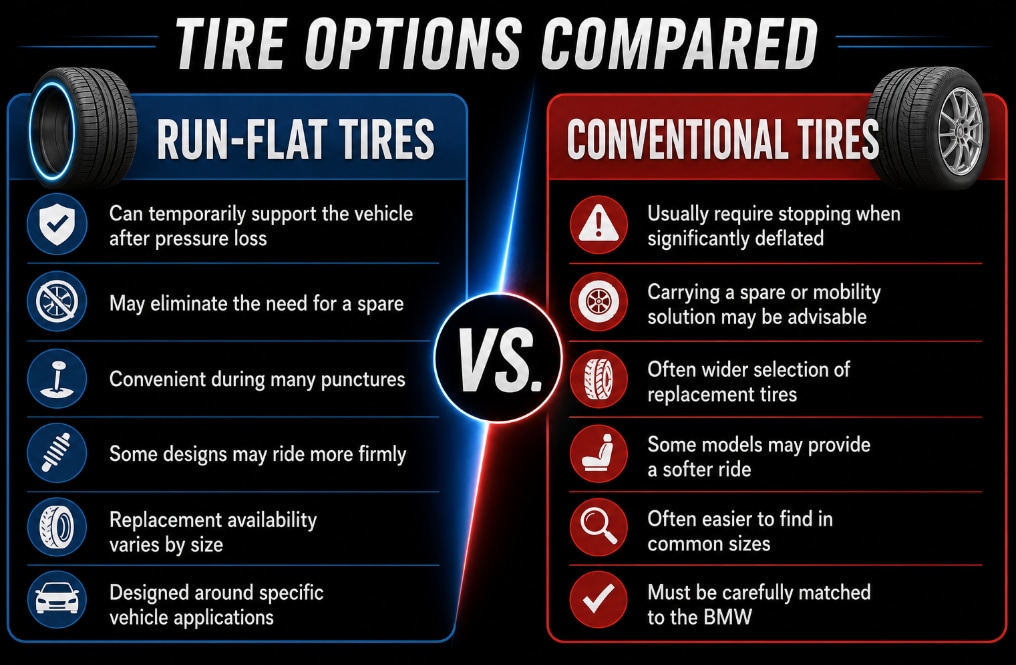
Run-Flat Tires vs. Regular Tires
Here's the basic trade-off:
Can You Put Regular Tires on a BMW That Came With Run-Flats?
In many cases, it may be possible to switch from run-flat tires to conventional tires, but you shouldn't simply buy four tires in the correct size and assume you're finished.
The replacement tires still need to meet the appropriate specifications for your particular BMW, including size, load and speed requirements.
BMW's Tire Pressure Monitor also needs to be configured appropriately. BMW provides vehicle-specific procedures for tire settings and resetting the monitoring system after tire changes.
This is one reason it's worth discussing the switch with a BMW service professional before ordering tires.
What happens if you get a flat?
If your BMW doesn't carry a spare tire and you replace the run-flats with conventional tires, you need a plan for punctures. Depending on your vehicle and tire setup, that could mean a compatible mobility solution or roadside assistance. Otherwise, the improved ride quality you wanted could turn into a tow truck call the first time you pick up a nail.
Do Run-Flat Tires Wear Out Faster?
Not necessarily.
Tire life depends on far more than whether the tire is run-flat.
Driving style, tire compound, wheel size, road conditions, alignment and inflation pressure all affect tread life. A BMW driven aggressively on performance tires is going to use tires differently from an X3 driven primarily on the highway. That's why mileage alone isn't always a useful way to determine whether BMW tires need replacement. Look at tread depth, wear patterns and overall tire condition.
Tire Pressure Matters More Than Many Drivers Realize
Whether you choose conventional or run-flat tires, correct tire pressure is essential. Modern BMW vehicles equipped with the appropriate operating systems can display current tire pressures through the vehicle's Tire Pressure Monitor. Depending on the model, tire temperatures may also be displayed. BMW notes that target pressures can change based on factors such as tire temperature and vehicle load.
Ignoring an underinflated tire can affect handling, tire wear and fuel efficiency. If one tire consistently loses pressure, don't simply keep adding air. Have it inspected.
Are Run-Flat Tires Good for Georgia Roads?
For many drivers in West Georgia and East Alabama, they make a lot of sense. Someone commuting between Columbus and Fort Moore may appreciate knowing that a puncture doesn't necessarily require an immediate roadside tire change. Likewise, drivers regularly traveling between Columbus and LaGrange may value the added mobility a run-flat can provide during longer highway trips.
On the other hand, if most of your driving is around town and ride comfort is your highest priority, you may be more interested in exploring conventional tire options.
There isn't one correct answer for every BMW owner.
Should You Replace All Four BMW Tires at Once?
Not always, but this becomes especially important on BMW xDrive vehicles. Tires on the same axle generally need to be properly matched, and significant differences in tire circumference or tread depth can be problematic on an all-wheel-drive vehicle.
If your BMW has xDrive and only one tire is damaged, have the complete set inspected before replacing just that tire.
Sometimes replacing one tire is appropriate. In other situations, replacing multiple tires may make more sense.
Are BMW Tires Covered Under BMW Ultimate Care?
Standard tires and wheels are not included in BMW Ultimate Care's scheduled maintenance coverage. BMW specifically lists tires and wheels, wheel alignment, tire balancing and tire rotation among exclusions from the standard maintenance program.
Additional tire or wheel protection may be available separately depending on your vehicle and coverage.
Should I Keep My BMW Run-Flats?
Keeping run-flat tires preserves the convenience the vehicle was originally designed to provide. They're particularly appealing if you regularly drive long distances, travel at night or simply don't want to deal with a conventional flat tire on the side of the road.
However, switching can make sense for some drivers. If ride comfort is your biggest priority and you're willing to accept the loss of run-flat capability, a properly selected conventional tire may be worth considering.
The important part is making the switch deliberately, rather than choosing tires based solely on price.
BMW Tire Service in Columbus, GA
Your tires influence much more than ride comfort. They're responsible for transmitting acceleration, braking and steering inputs to the road. Before switching tire types, have your current tires evaluated and make sure the replacements are appropriate for your specific BMW.
BMW owners throughout Columbus, Fort Moore, Midland, Phenix City and LaGrange can visit BMW of Columbus for tire inspection, replacement and BMW service.